The End of Prediction: Why Adaptive Cognitive Infrastructure is the New Alpha Standard

Predictive investing relies on historical patterns to forecast future price action - a method prone to failure during regime shifts. Adaptive investing, powered by Vertus, utilizes recursive inference to adjust its internal logic in real-time.
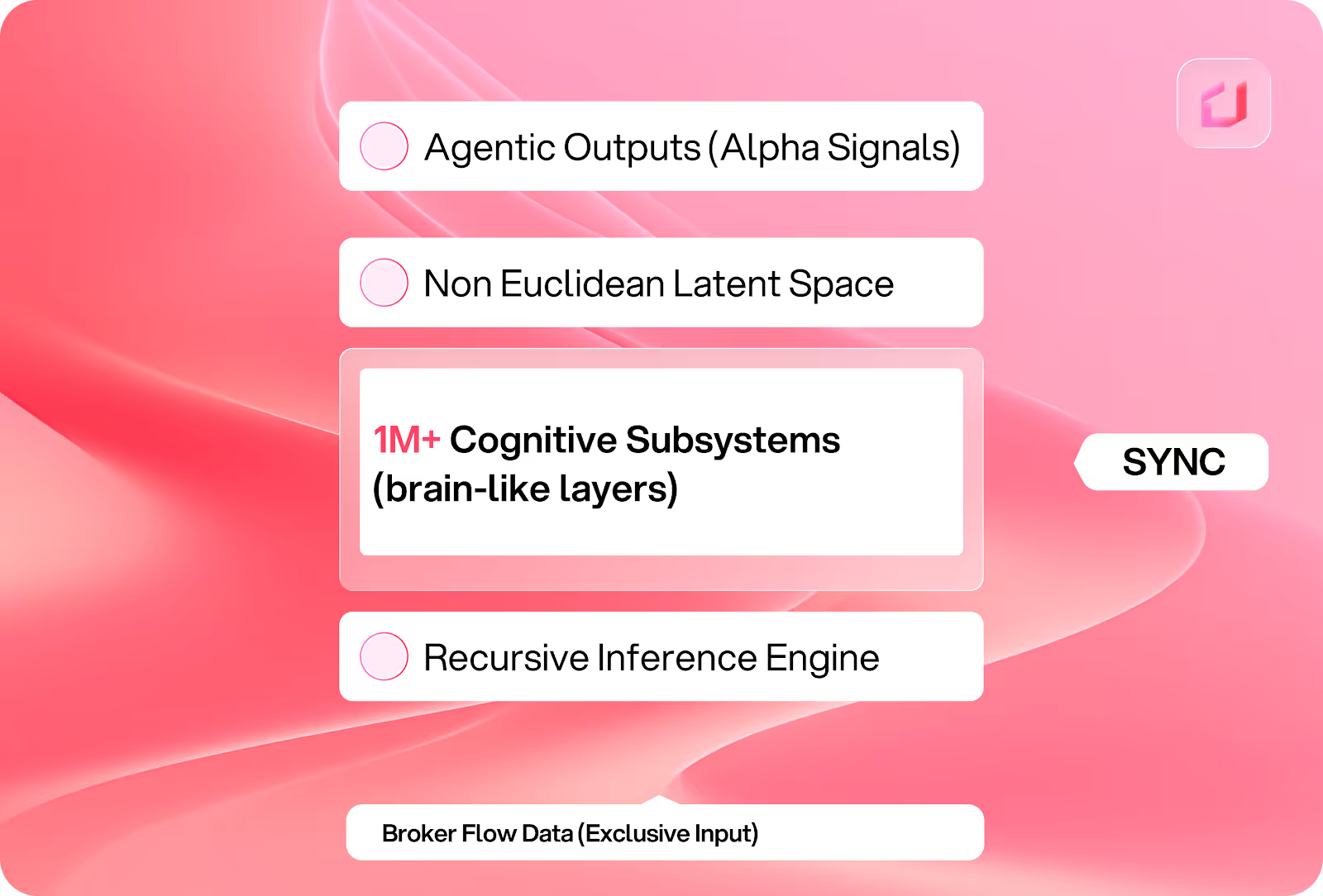
By processing exclusive broker flow data through 1M+ cognitive subsystems, it navigates market volatility as a living architecture, not a static model.
The 2025 Predictive Collapse: A Post-Mortem on Legacy AI
Traditional machine learning models reached a structural breaking point during recent market dislocations. The Data Lag problem proved that forecasting based on decayed information is no longer a strategy - it is an operational vulnerability.
- The Failure of Static Pattern Matching: Most "Legacy AI" systems assume the future is a mirror of the past, losing the cognitive flex required to interpret unprecedented volatility.
- Model Decay in High-Frequency Regimes: In a market with a $9.6 trillion daily turnover, static logic becomes a liability that requires constant manual re-training, which simply cannot keep pace with realit
The Evolution of Market Survival: Adaptive vs Predictive Investing
In 2025, the financial landscape hit a sound barrier that static models were never designed to cross. As market regimes shifted with supersonic speed, traditional forecasting disintegrated like a legacy airframe under extreme G-force.
For CIOs and managers overseeing $100M+ AUM, the "prediction gap" has become a structural risk that can no longer be ignored. Traditional investing relies on historical patterns - a method that inevitably leads to a terminal stall during structural regime shifts.
The Mechanics of Cognitive Alpha Generation
Adaptive Investing, powered by Vertus, is not a divination of the past. It is a living architecture utilizing Recursive Inference to rewrite its own logic in real-time.
- Recursive Inference: The system continuously updates its "worldview" with every tick of data, converting outputs into fuel for new cognitive iterations.
- Cognitive Signals: We transform exclusive broker money flow into Real-time Market Cognition, the only data that truly matters in 2026.
- Living Architecture: More than 1 million cognitive subsystems analyze volatility not as a static model, but as a dynamic intelligence that adapts faster than the market itself.
This is the moment you stop betting on the accuracy of a forecast and start operating a system that evolves with the storm.
From Forecasting to Cognition: How Adaptive Models Think
Traditional automation in finance has finally hit its glass ceiling. While the industry focused on making legacy algorithms faster, Vertus made them smarter by evolving standard execution into Agentic Portfolio Management.
This system does not attempt to "guess" the future. It perceives the market as a dynamic, non-stationary environment. Instead of following rigid rules, the Vertus core adapts its entire decision-making topology to the specific current market state.
Brain-Like Architecture vs. Model Decay
Any standard AI model eventually degrades, losing relevance as market cycles shift - a phenomenon we call "logic entropy". Vertus solves this by mimicking biological neural adaptation.
Our architecture is not static. It restructures itself with every single query. This allows the system to avoid stagnation by constantly updating its internal connections, making it resilient even during the most abrupt market phase transitions.
Non-Euclidean Latent Space
Vertus processes data within a high-dimensional latent space. This allows the system to map complex, non-linear relationships that traditional Euclidean models simply cannot "see" due to their mathematical constraints.
The Broker Flow Advantage
Information is the lifeblood of any system, but not all data is created equal. Most platforms digest public information that has already been priced in by the time it reaches them. The Vertus Superintelligence Core utilizes exclusive broker money flow as its primary cognitive signal.
This proprietary stream grants the system access to "hidden liquidity" that remains invisible to models operating on decayed public data.
We don't just analyze charts. We perceive the intent of major capital and identify zones of institutional interest long before they stir a market storm. This provides you with a decisive edge - the ability to act with conviction while others are still struggling to comprehend what just happened.
Strategic Comparison: The Institutional Efficiency Gap
Your leadership in 2026 depends on one persistent question: does your infrastructure simply support an outdated process, or can it guarantee results in the event of failure? For decision makers, the line between strategic asset and structural liability is now defined by the system’s ability to autonomously cognitively adapt.
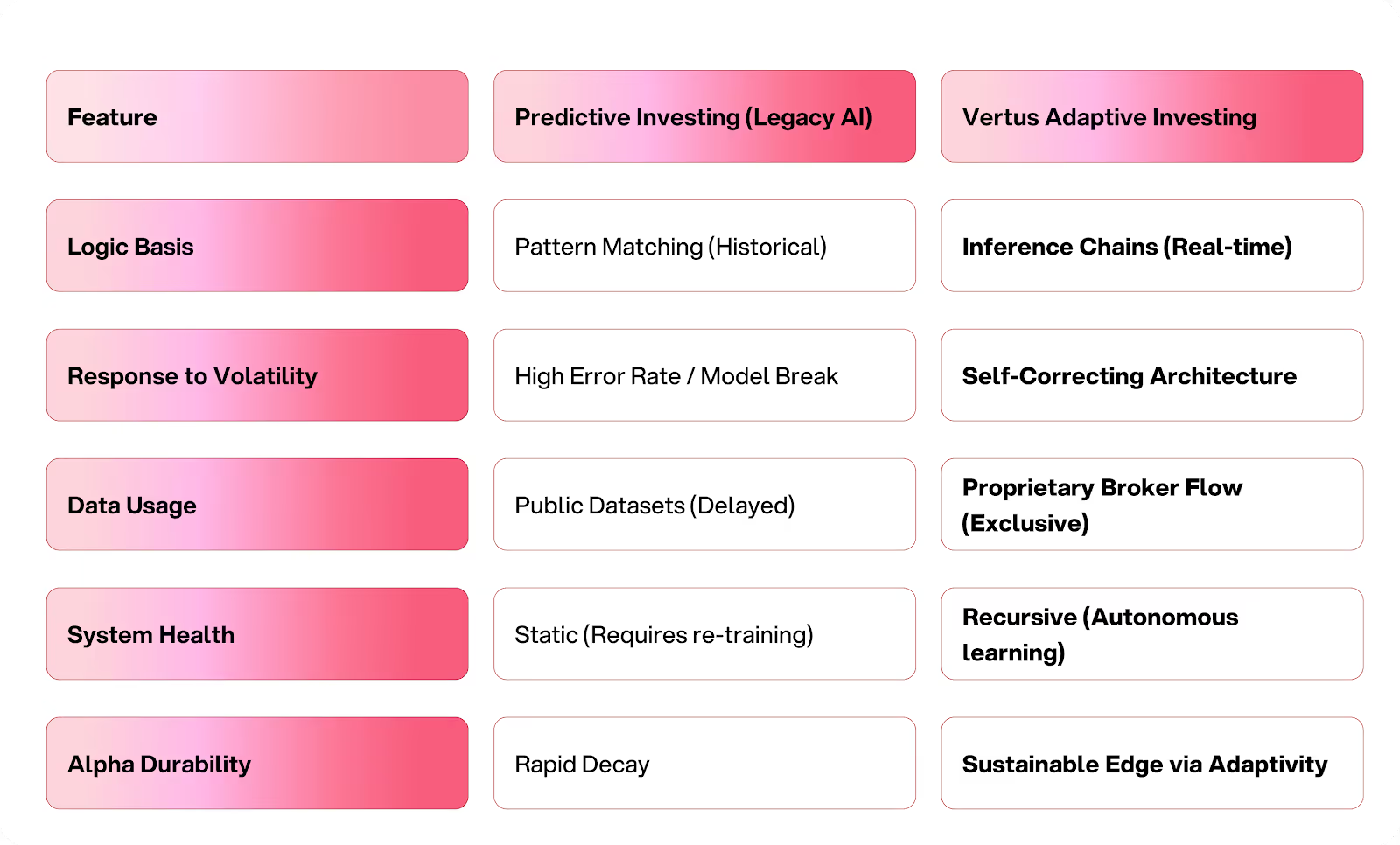
Deploying Adaptive Infrastructure: From Ownership to Autonomy
Institutional capital in 2026 demands more than a license. It requires a cognitive foundation. The ultimate question for your board is no longer which tools you own, but how much autonomy your systems possess when the market deviates from the script. Are you merely supervising a legacy process, or operating a system that evolves with the storm?
Vertus Institutional Infrastructure
We provide a managed institutional AI trading infrastructure specifically for $100M+ AUM. This environment ensures your proprietary strategies are wrapped in a sovereign, adaptive shell that restructures itself per query to eliminate "logic entropy". It is the transition from manual recalibration to a system that identifies liquidity dry-ups before they manifest in lagging price charts.
The Intelligence API
For teams requiring programmatic access, the Intelligence API offers a direct bridge to our proprietary superintelligence core architecture. Quant researchers can integrate real-time market cognition and our Non-Euclidean Latent Space mapping directly into existing stacks. By leveraging the Intelligence API for programmatic access, you feed internal models with the exclusive broker flow that powers the entire Vertus ecosystem.
In an era where static logic is a liability, the shift to adaptive infrastructure is the only way to ensure your capital remains resilient, responsive, and relevant.
Strategic FAQ
Q: Why do predictive AI models fail in finance?
A: They assume the future will resemble the past and lack the "cognitive flex" to interpret unprecedented variables.
Q: What is 'Recursive Inference' in the context of Vertus?
A: It is the system's ability to feed its own outputs back into its logic core, updating its "worldview" with every tick of data.
Q: Is Adaptive Investing safer for institutional capital?
A: Yes. It builds in "risk-cognition" that detects liquidity dry-ups before they manifest in lagging price data.
The following infographic illustrates the stark divergence between the fragile, linear nature of legacy forecasting and the resilient, self-updating cycle of the Vertus adaptive loop:
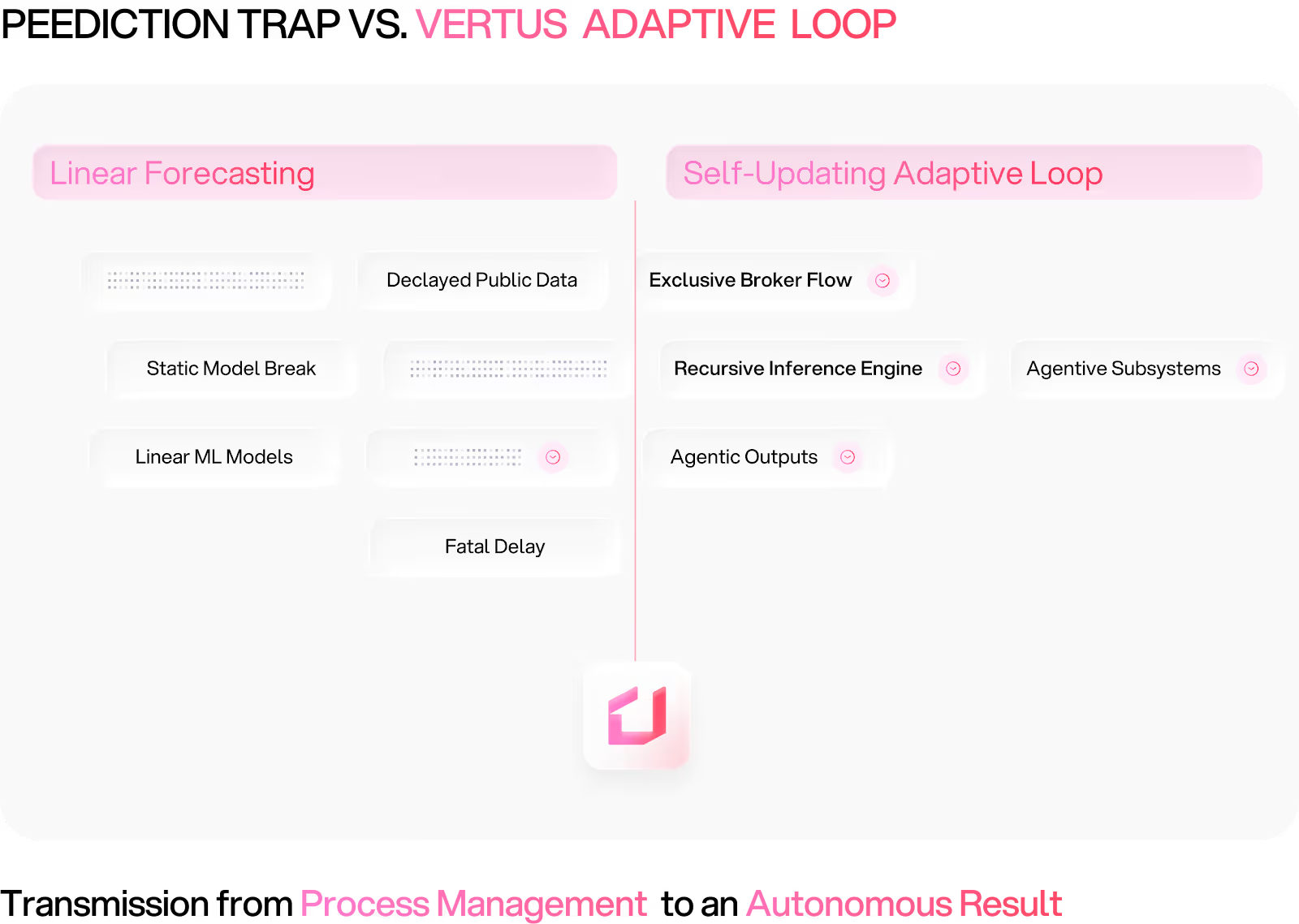
The future of institutional capital belongs to those who operate a living architecture capable of transforming market volatility into a sustained cognitive advantage.
In an era of rapid regime shifts, success depends on transitioning to systems that autonomously evolve alongside the storm.
.png)
.avif)