The Agentic Shift: Redefining AI in Institutional Asset Management

In a world where public AI is as ubiquitous as morning coffee, institutional capital is on the brink of collapse. We see AI everywhere, hear it every day, and embed it in every link in the chain. But is “intelligent fashion” a real foundation when mistakes cost millions?
The gap between generative chatbots and deterministic market judgment is now deadly for hedge funds and family offices. Relying on retail “wrappers” is like navigating a transatlantic liner with a compass from a souvenir shop - it’s a direct operational risk.
Are you willing to entrust capital to a system that “guesses” words instead of calculating liquidity?
This article is not about technology. It is about the architecture of survival. What lies ahead is understanding the hidden data flows that public models cannot see, and the path to creating your own sovereign intelligence.
%20(1).avif)
The Conflict: The Alpha Decay of 2025
The previous year proved that retail AI wrappers are a liability. When every fund uses the same public LLM, alpha disappears into a sea of correlated trades and "hallucinated" risk parameters.
The Correlation Trap
Public models trained on the yang of identical datasets triggered a "herd mentality" across global portfolios. This led to synchronized exits and a catastrophic collapse of unique strategy returns.
The Failure of Generic Risk Logic
Standard AI lacks the deterministic rigor needed for high-stakes capital. Relying on probabilistic "guesses" caused 21% of funds to overshoot their risk mandates during the 2025 volatility.
The Information Lag Premium
Retail wrappers operate on a data delay that is fatal in millisecond-sensitive markets. By the time a public LLM processes an SEC filing, the institutional advantage has already been captured by sovereign systems.
The Solution: Agentic AI for Finance
The world of forecasting is over. In 2026, leadership belongs to those who create agent-based cognitive infrastructure capable of autonomous thinking.
At Vertus, we have moved from passive algorithms to systems with “agentic will.” This architecture understands the market context as deeply as an experienced manager operating at the scale of supercomputers.
Cognitive Portfolio Construction
We replace linguistic probability with architectural certainty. Cognitive Portfolio Construction shifts asset allocation from static models to dynamic, real-time portfolio formation.
By utilizing Recursive Inference to model liquidity scenarios every second, the system builds portfolios that intelligently adapt to volatility. This ensures capital "immunity" amid the complex market shifts of 2026.
Proprietary Signal Processing
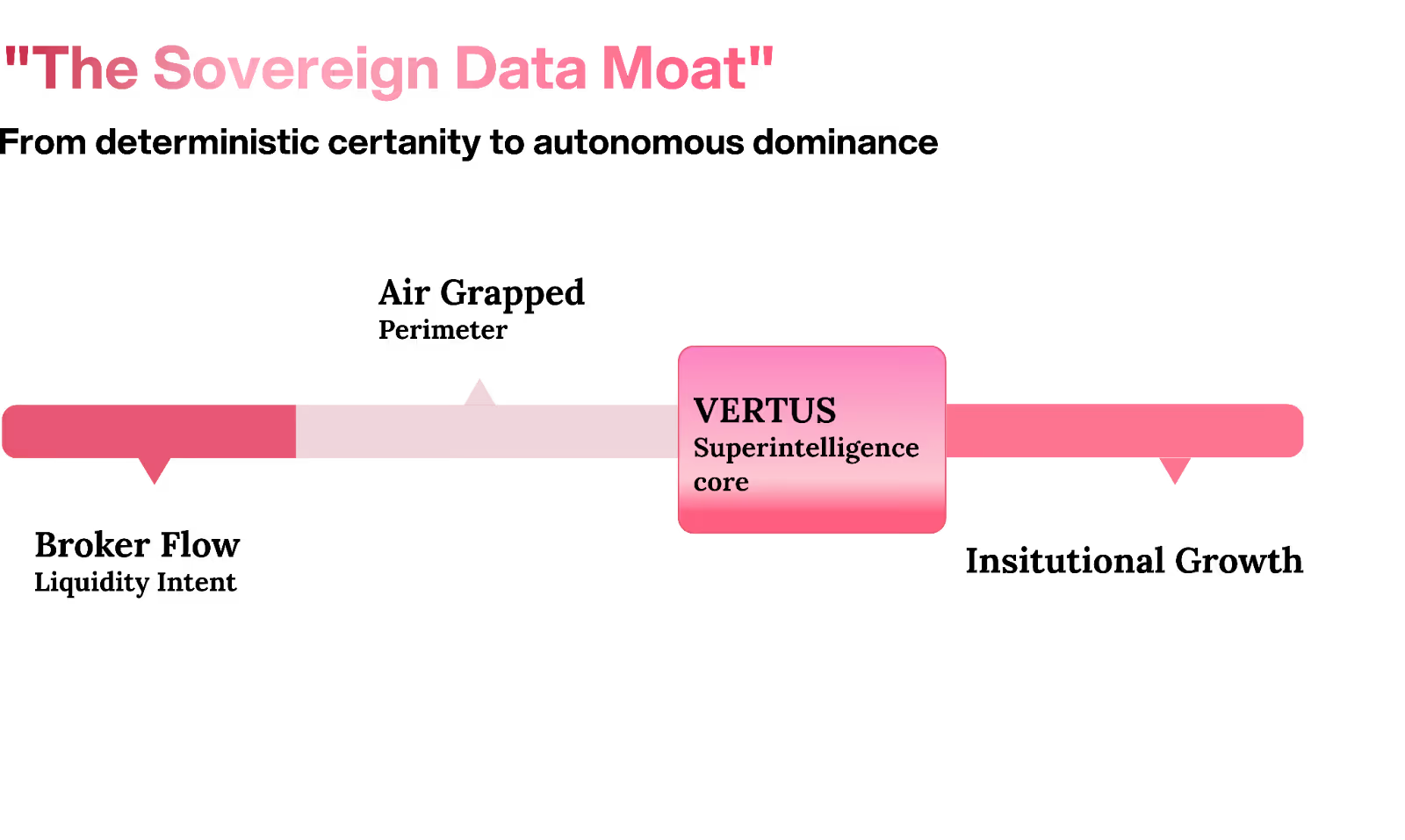
The real advantage lies where public AI can’t see. While retail models feed on stale news, our intelligence is trained on proprietary data about broker flows.
This reveals market “intentions,” not just price. Our proprietary LLM in finance uncovers hidden liquidity and large-scale capital movements before they manifest as public trends.
Recursive Inference
Unlike linear models, the Vertus kernel uses Recursive Inference for real-time risk weighing . This proprietary superintelligence core is validated across 1M+ subsystems, ensuring massive computational rigor.
When regimes shift, the system "reasons" through liquidity in milliseconds. Every outcome is a result of architectural determinism, providing a high-stakes certainty that generic AI wrappers cannot match.
“In 2026, the winner will not be the one with the fastest algorithm, but the one whose intelligence understands the geometry of the market ahead of the competition.”
Vertus provides the Sovereign Intelligence Layer for asset managers who have outgrown generic AI. Our architecture moves beyond "chatting" into the realm of autonomous, auditable decision-making
Tactical Execution: Vertus Institutional vs. Intelligence API
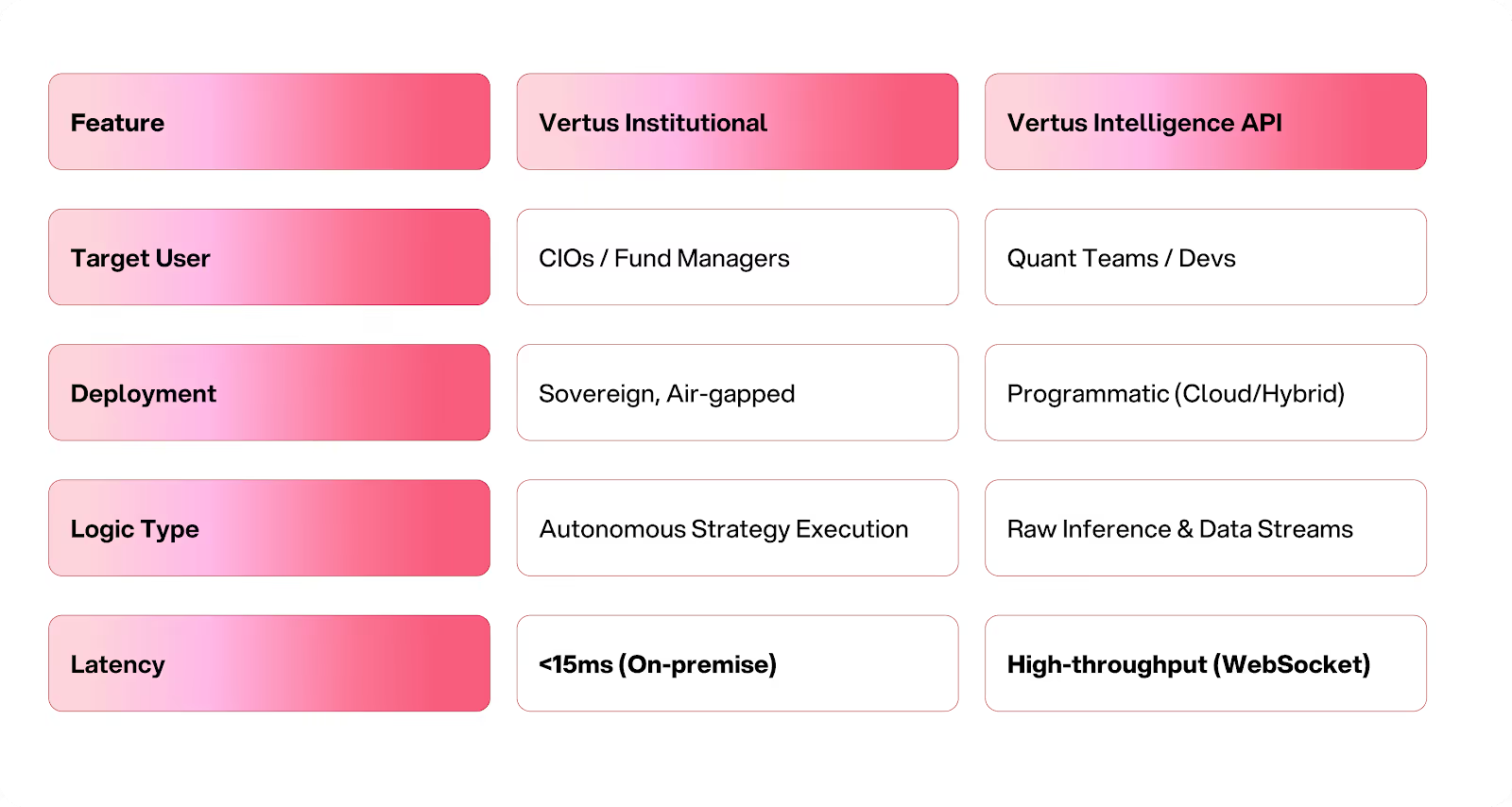
Choosing the right infrastructure is a balance between your company’s technical depth and its operational mandate for autonomy. Whether you need a fully integrated sovereign fortress or a high-speed software core, this decision determines your speed to market.
Explore the following architectural paths to determine which engine will drive your institutional alpha in 2026.
Tactical Execution: Deployment Paths to Alpha
Operational success in 2026 is defined by the synergy between your technical stack and the requirement for total data isolation. Your choice between a fully managed sovereign environment or a high-velocity programmatic core determines ultimate agility in complex markets.
Vertus Institutional: The Hedge Fund Fortress
For organizations managing $500M+ AUM, data security is the only non-negotiable metric. Vertus Institutional provides a managed institutional hedgefund infrastructure deployed directly within your own perimeter.
This air-gapped environment ensures your proprietary alpha never leaves your organization. It eliminates third-party cloud dependencies while meeting the strictest regulatory hygiene protocols of 2026.
Vertus Intelligence API: Fuel for Quant Quests
Designed for quantitative teams requiring raw, programmable power to fuel bespoke strategies. The API grants direct programmatic LLM access for quants to our Superintelligence Core.
Developers can integrate Recursive Inference logic directly into custom tech stacks via high-velocity data streams. This allows for real-time cognitive inference on top of our exclusive Broker Flow foundation.
Strategic FAQ: Technical & Compliance Focus
Q: How does agentic AI differ from traditional algorithmic trading?
A: Agentic AI uses cognitive reasoning to adapt to "regime shifts" in real-time, whereas traditional algos remain fixed to pre-set, static parameters.
Q: Is Vertus compliant with SEC 2026 AI disclosure rules?
A: Yes. Our proprietary superintelligence core provides full Inference Traceability, allowing compliance teams to audit the deterministic logic behind every agentic decision.
Q: What is the barrier to entry for Intelligence API integration?
A: It is built for institutional quant teams requiring programmatic access to financial LLMs via WebSocket/REST, ensuring seamless integration with existing tech stacks.
The New Standard: From Strategy to Momentum
In 2026, AI is no longer a topic of discussion. It is the fundamental life support system of the capital. In a landscape where speed of inference dictates market dominance, any delay becomes a mathematically proven loss.
We designed Vertus as an architecture for growth dominance. It is a shift from probabilistic guesswork to deterministic certainty, where every node in the system reinforces your institutional advantage.
The future is already unfolding. Flip the switch.
.png)
.avif)