The Future of Quant Funds: Why Sovereign Intelligence is the Only Defensible Edge

.avif)
The Future of Quant Funds is defined by a structural shift from predictive modeling to Agentic Cognitive Infrastructure. This involves the deployment of sovereign, air-gapped LLMs trained on exclusive broker flow data, enabling autonomous market reasoning that satisfies SEC 2026 transparency requirements while mitigating the alpha decay found in public-cloud AI
By 2025, the financial landscape reached a structural breaking point where static forecasting models shifted from assets to liabilities. For institutional players, this year became a moment of truth: invincible strategies collapsed as the era of simple predictive modeling met its end.
The Death of the "Public-Cloud Quant"
We are witnessing "digital cannibalism": as public LLMs train on their own synthetic data, they create a "hall of mirrors" effect.
These models hallucinate non-existent market correlations, ending the intellectual dominance of funds with AUM $500M+ that rely on general APIs. Public cloud usage has become "diluted fuel" - the appearance of power remains, but the internal combustion of alpha has stalled.
The Commoditization Trap of Standard APIs
Today, standard API-based trading is a "trap of uniformity." When thousands of quants plug into the same proprietary "black boxes" of tech giants, they inevitably converge on the same conclusions.
- Alpha Decay: The edge evaporates the moment an algorithm becomes accessible to the masses.
- Legacy Latency: While public models struggle to process requests through congested servers, the market regime has already shifted.
- Synthetic Pollution: Public data is now poisoned by synthetic noise, leaving predictive models vulnerable to fatal errors during real-world storms.
In 2026, high-quality backtesting shows that model accuracy has dropped from an expected 90% to a reality of 65-75% due to unforeseen market volatility.
This is not just a technical delay. This is a strategic dead end. In 2026, true market power belongs to those who own their own isolated, sovereign cognitive infrastructure.
Quant 2026: Moving from 'AI-Enabled' to 'AI-Native' Infrastructure
Imagine a trading floor where the air no longer crackles with the static of human hesitation. In 2026, the most powerful desks aren't just "using" AI. They are breathing through it. The era of the "bolt-on" algorithm is over. We have entered the age of the AI-Native firm, where intelligence is the pulse, not the peripheral.
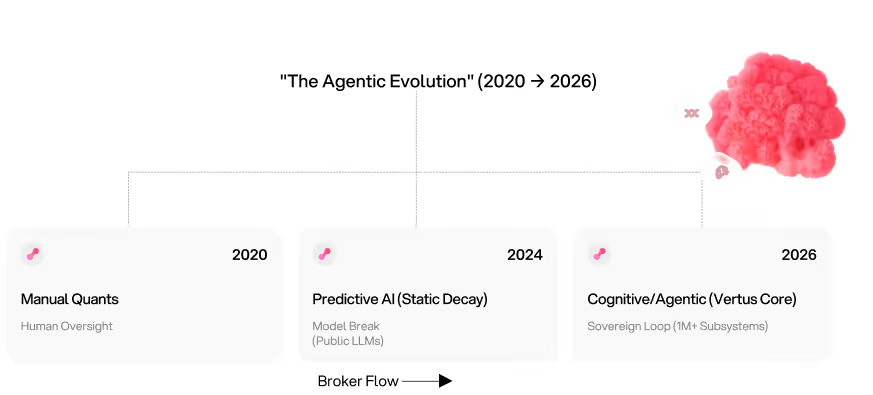
Winning quants have replaced fragmented toolchains with a Cognitive Operating System (COS).
This integrated architecture uses high-throughput scheduling to accelerate research cycles, ensuring you see alpha before the consensus even wakes up.
The End of AI Washing: The "Verify-then-Trust" Model
The SEC 2026 Examination Priorities have killed the "black-box" era. Regulators now demand Deterministic Inference Traceability for every fiduciary decision.
- Explainable AI Dashboards: Interfaces must now allow humans to interrogate the "why" behind every signal.
- Audit-Grade Standards: Governance frameworks now require model registries to block drift and leakage before production.
- Sovereign Compliance: Firms are migrating to Sovereign Stacks - air-gapped environments that neutralize public-cloud surveillance risks.
Agentic Autonomy: AI as a Cognitive Operating System (COS)
The 2026 leaders have transitioned to Agentic AI - goal-driven systems that reason and execute without constant hand-holding.
- Autonomous Workflows: Agents manage the full cycle, from detecting portfolio drift to executing intent-based rebalancing.
- Dynamic Neural Topology: Systems now restructure their own logic per query, eliminating the model degradation of static algorithms.
- Zero Data Retention (ZDR): COS environments enforce ZDR protocols to ensure proprietary research never leaks into the public domain.
By deploying AI as a living system, AI-Native firms reduce operational cycles by 40% to 70%, creating a structural gap that human-dependent workflows can no longer bridge.
Sovereign Infrastructure: Security as a Standard
For institutional capital in 2026, data sovereignty is a primary instinct for survival. Here, security is not a configuration. It is an architectural foundation where every millisecond of a strategy is shielded from external interference.
Zero Data Retention (ZDR) and Privacy
The Vertus core operates on the principle of digital ephemerality: the Zero Data Retention protocol prevents your alpha from leaking into public clouds. This ensures the highest regulatory hygiene of 2026, leaving every byte as your exclusive intellectual property.
Sub-15ms Inference and Technical Edge
Dominance belongs to those who outpace the consensus. Our sovereign stack delivers Sub-15ms Inference speeds, eliminating the "latency tax" of public models and transitioning to instantaneous market cognition at the true tempo of capital.
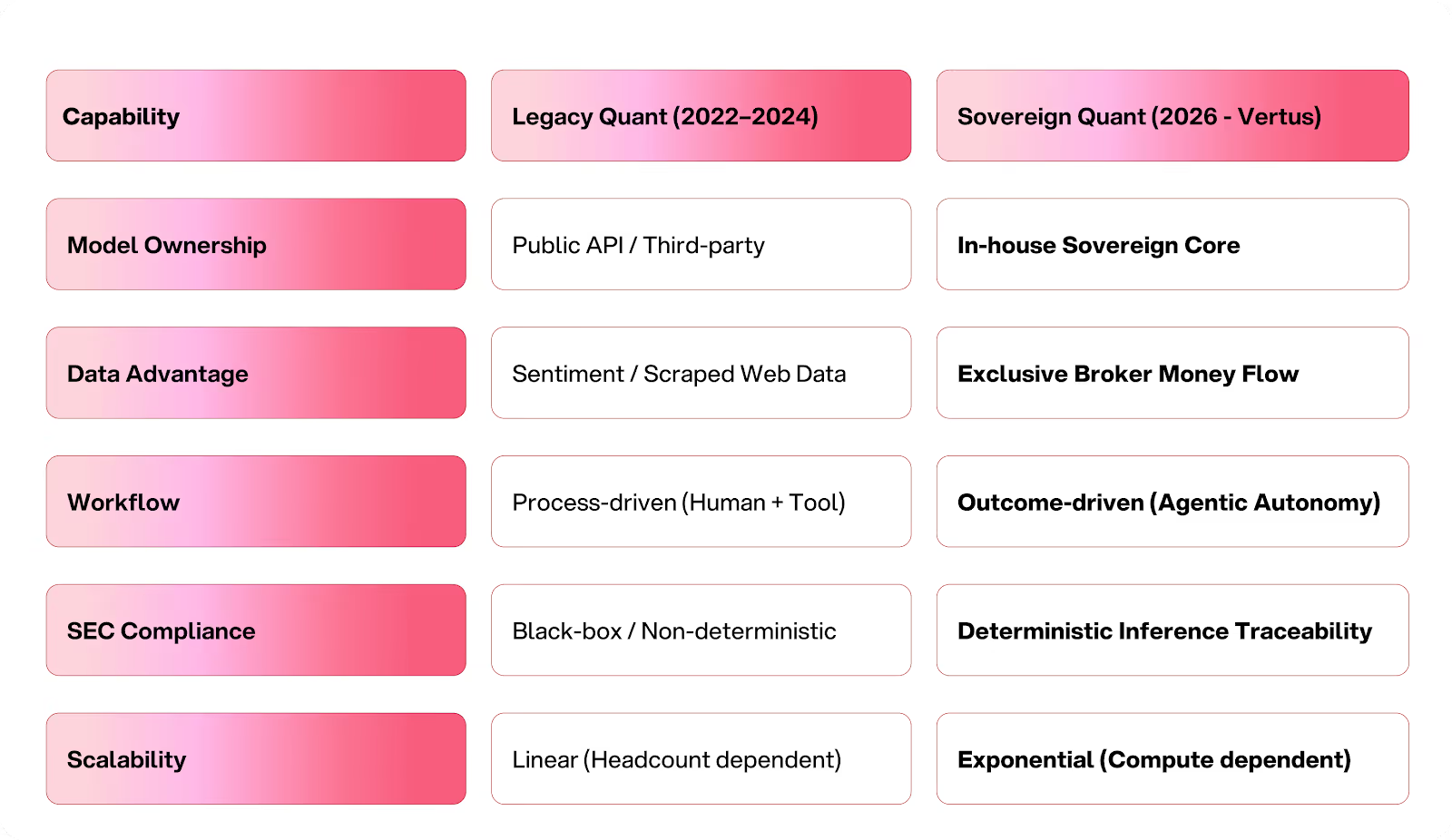
The Structural Realignment: Legacy vs. Sovereign Quant
Alpha is no longer found in the data itself, but in the architecture that processes it. While the industry struggles to squeeze the last drops of profit from dying strategies, the real divide in 2026 lies between two incompatible capital philosophies.
Is your infrastructure ready to become a living part of the market?
Institutional Scaling
The final frontier for Future of Quant Funds is eliminating the "research-to-production" lag. Vertus provides the AI-Native foundation to bridge this gap for global capital, turning theoretical models into live market power.
The Intelligence API: Programmatic Reasoning
The Vertus Intelligence API acts as a cognitive plug-in with Sub-15ms Inference.
- Usage-Based Intelligence: Trigger real-time inference across multi-modal institutional data (filings, transcripts, flow) with full citation.
- Inference Traceability: Every call generates a deterministic audit trail to meet the "Verify-then-Trust" regulatory mandate.
Institutional Infrastructure: The Sovereign Fabric
Scaling AUM $500M+ requires a Sovereign Stack engineered for operational resilience.
- 1M+ Validated Subsystems: Supports massive concurrency for thousands of parallel stress scenarios without performance degradation.
- Zero Data Retention (ZDR): Air-gapped isolation ensures your proprietary edge remains private and secure from public-cloud risks.
- Agentic Autonomy: Transitioning to autonomous workflows reduces operational cycles by 40% to 70%.
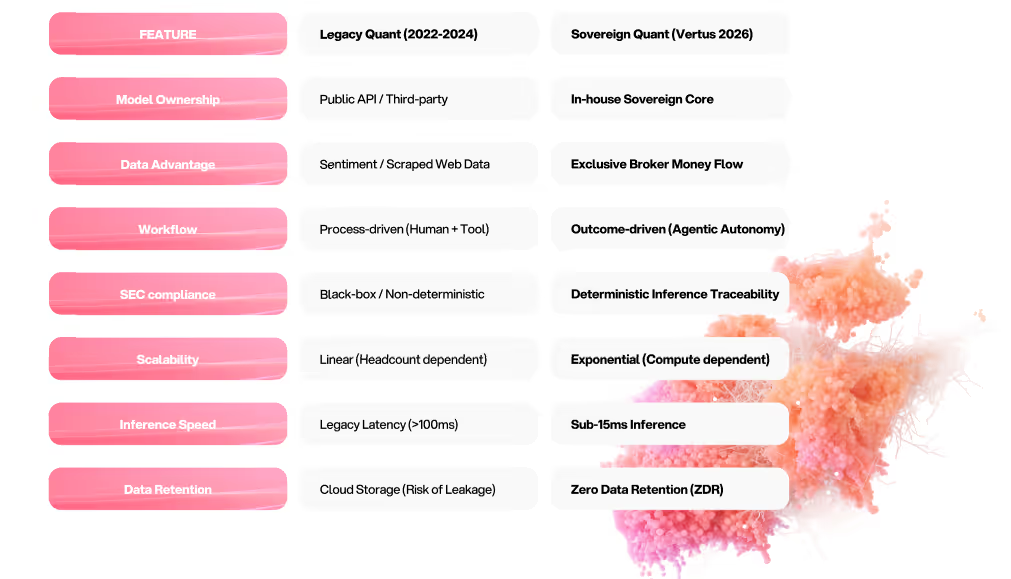
In 2026, the choice is binary: manage fragmented legacy tools or deploy a Cognitive Operating System. Vertus turns institutional ambition into market dominance.
Strategic FAQ
Q: What are the SEC's AI supervision priorities for 2026?
A: Examiners are focusing on the accuracy of AI claims and the "Explainability" of algorithmic logic, particularly in fiduciary decision-making.
Q: How do agentic workflows solve alpha decay?
A: By autonomously identifying and adapting to non-linear regime shifts in real-time, bypassing the lag of manual model re-training.
Q: Is the Vertus Superintelligence Core compatible with existing data rooms (VDRs)?
A: Yes, it is designed to ingest and synthesize multi-modal institutional data (filings, transcripts, flow) with full citation for auditability.
Institutional Scaling: The Path Forward
Bridging the gap between research and production requires more than a tool, but a foundation built for the agentic era. The transition from a "Predictive" mindset to a "Cognitive" one is the defining pivot of 2026.
Vertus provides the proprietary superintelligence core and institutional hedgefund infrastructure required to lead this structural shift. By deploying on a sovereign foundation, quant teams can eliminate alpha decay and ensure deterministic compliance from day one.
Stop managing legacy friction and start deploying intelligence. Request a Technical Briefing on Institutional Infrastructure -> https://www.vertus.ai/investment
Get API Documentation for Quant Researchers -> https://www.vertus.ai/partners
Quant teams can now leverage our Intelligence API for financial quants to architect the next generation of defensible alpha on a truly sovereign foundation.
.png)